
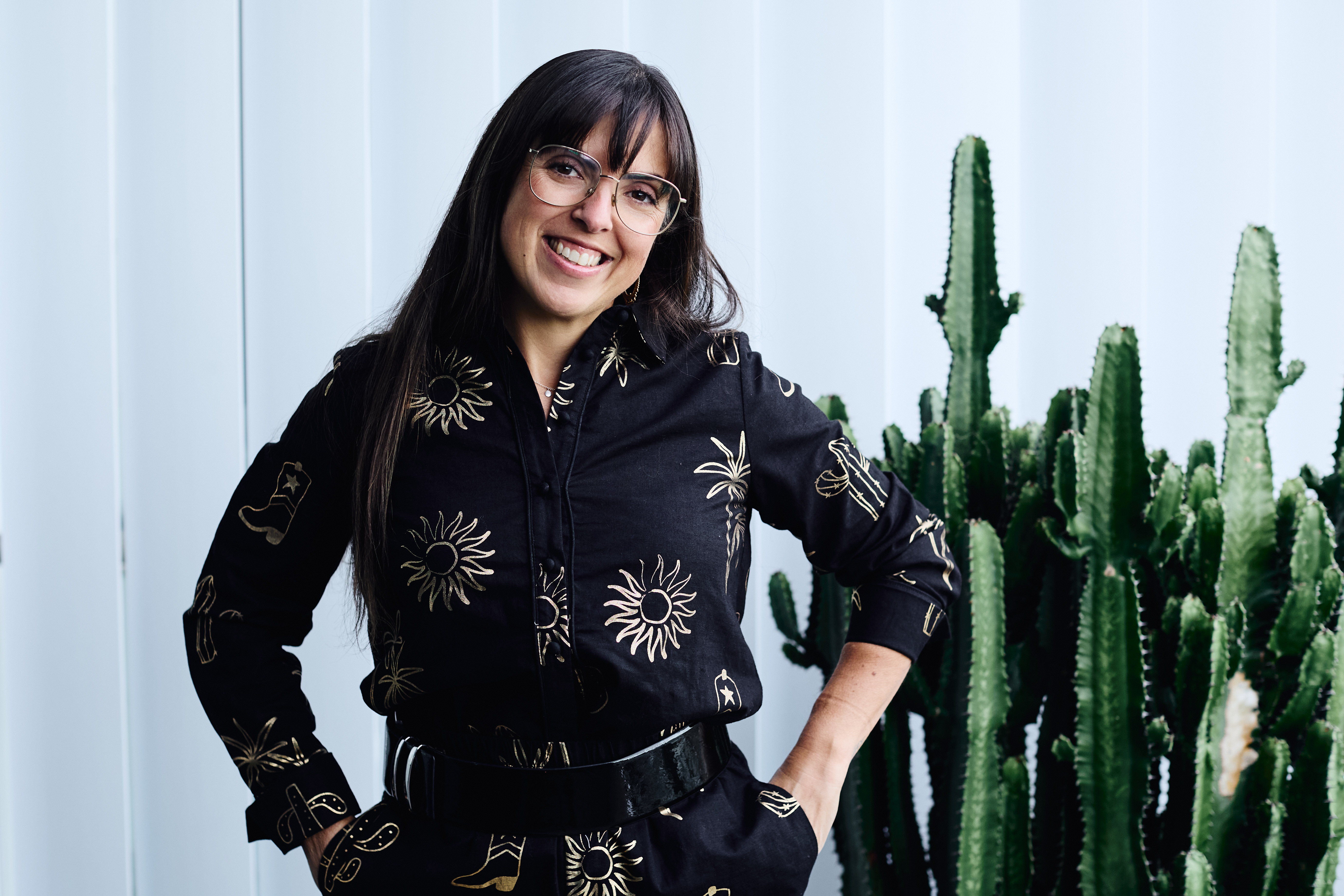
Life Lesson #4: What if you stopped being afraid of who you are?
For a lot of my childhood, the message was pretty clear.
Don't be too loud.
Don’t be too much.
Don't hurt yourself.
Fit in. Even though we looked and sounded different.
Keep the peace.
My parents weren’t people who talked openly about feelings or emotions either. Difficult
feelings weren’t necessarily explored or given language. They were more often pushed
down, moved past, got on with.
And so, somewhere along the way, I became very good at shrinking.
Not necessarily physically.
But emotionally. Energetically. In the amount of space I allowed myself to occupy.
For a long time, I thought this was simply part of my personality.
I now understand that much of it was learned.
The person I thought I needed to be
That conditioning followed me into my career.
In the early years, I curated myself quite heavily. Pencil skirt, blow-dried bob and heels was
my brand.
I knew how I wanted to be perceived. Professional. Capable. Together. Ambitious, but not
too ambitious. Confident, but not enough to make anyone uncomfortable.
I was working middle-management marketing, so perhaps there is some irony in this.
There were parts of me I softened. Parts I edited. Parts I kept out of the room because I
wasn't convinced they belonged there.
Underneath it was a pretty simple fear:
What happens if I let people see all of me and they decide I'm too much?
I just wanted to belong, but by holding myself back, I never truly did belong. Occasionally, I'd
find my people. The people I'd go for drinks with after work and have a vent about the
matrixed, corporate culture we were in that didn't fit our values system of wanting to speak
up and take action.
We become incredibly sophisticated at reading the room.
We learnt what gets rewarded and receives approval.
And without consciously deciding to, we began constructing an identity around fitting in, so
we'd get the pay rise, promotion or people in our team.
Then something shifts
One of the most interesting things about being in my mid-40s and doing this work is that I am
becoming much less interested in fitting into an existing version of myself.
I'm far more interested in the person I'm becoming. And I'm more comfortable in the person I
am. Less shy about all the parts of myself, including the shadow.
And there's something incredibly liberating about that. Does anyone else resonate?
Lately, I've been a little obsessed with Emma Grede.
Not because I want to be Emma Grede.
But because I find certain qualities in her fascinating.
She's polished and commercially sharp, but what really gets my attention is how
unapologetic she seems to be about her ambition and her capability.
She'll talk about making money.
She'll talk about losing money.
She'll talk about what she's brilliant at.
She talks about how she parents. And for some, her approach would be polarising.
She takes up space without appearing to apologise for occupying it.
And I find myself thinking:
I want more of that.
Not her businesses. Not her life. Not her exact personality.
That quality.
The willingness to own what you are good at.
The permission to be ambitious.
And I've realised there is something important in that.
We can choose who we are becoming
A large part of the work I now do with leaders using NLP is around getting incredibly clear
about the outcome we want. In fact, I do the same with my marketing and PR clients. I ask
people to get crystal clear about the outcome they want for themselves or their business.
Because once you have clarity about where you are going, you can start asking a different
set of questions.
Who do I need to become to create that outcome?
How does that version of me think, and act?
This isn't about pretending to be someone you're not. For me, it's almost the opposite.
It's about deliberately strengthening parts of yourself that may have been pushed down,
discouraged or never given much room to develop.
We do this naturally in other areas of our lives. For example;
We learn leadership by observing leaders.
We learn communication by watching great communicators.
We parent how our parents taught us, or we rebel and do quite the opposite
We learn about relationships by absorbing what we see around us.
So why wouldn't we consciously expose ourselves to people who represent some of the
qualities we want to embody?

Now for the harder part...
It's all fair and well to dress and try on the leader you respect. But changing your
programming, your mindset, thoughts and behaviours is another ballgame.
Listen carefully to the language running through your mind.
I look fat in this. I'm getting old. I'm* not ready. *You're just...
Maybe don't say that. Don't be too much.
If those sentences sound familiar, ask yourself something important:
Whose voice is that?
And is it still serving the person you're becoming?
Our internal language is powerful because when we repeat something often enough, it can
stop sounding like an opinion and start sounding like a fact. They are very often stories or
inherited beliefs.
And both can be rewritten.
The life lesson
Perhaps growing into ourselves isn't about doing or being more. It's about admiring the
person we have become and being less afraid to truly see yourself.
WORDS MATTER
This idea of consciously designing who you're becoming is one of the exercises we'll explore
in my upcoming Words Matter Masterclass.
We'll look at the language and stories running quietly in the background, the way they
influence how we show up, and how we can start creating a clearer internal picture of the
person we want to become.
Because before we can change the way we show up in the world, we need to become aware
of the conversation we're having with ourselves.
A question to sit with
If you weren't worried about being judged, being “too much”, or getting it wrong —
what part of yourself would you allow people to see more of?